



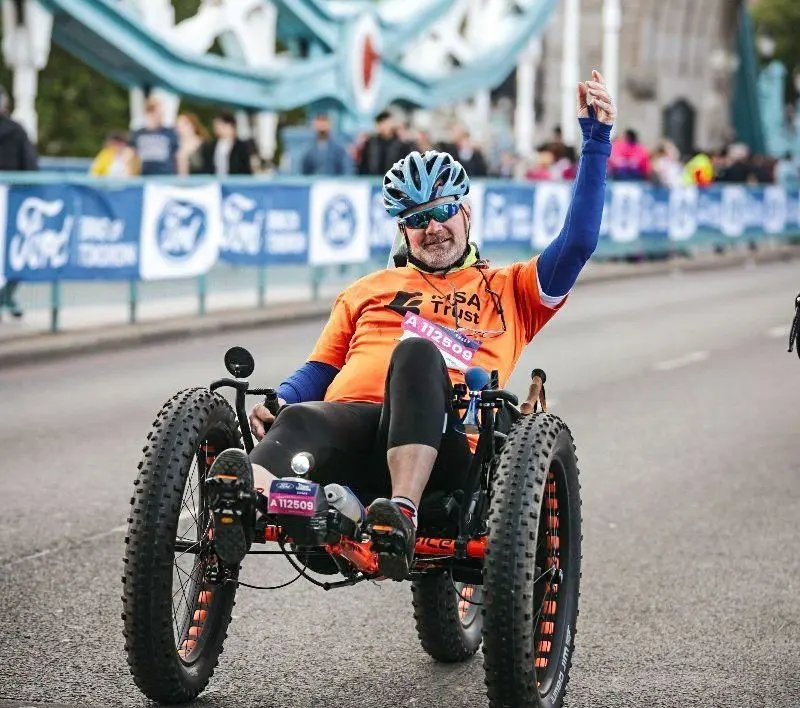





This factsheet forms part of a series focusing on equipment and aids that may be of benefit to people living with MSA. It looks at equipment and aids relating to posture and mobility. There is a vast range of equipment available, so this list is not exhaustive. The factsheet has been developed with the aim of giving you an idea of what type of equipment is available.
It is vital that you discuss with your Physiotherapist or Occupational Therapist any items you are considering buying to help with your posture and mobility. Many items need to be the right size or specially measured to be safe and effective. These health professionals are best qualified to determine this. They will also know what items might be available to you free of charge through local services.
The MSA Trust does not endorse or recommend any specific product mentioned in this factsheet. We do not receive money from any organisation mentioned.
Healthcare Professionals
Occupational Therapist
An OT (Occupational Therapist) should be one of the members of your multi-disciplinary team. They are ideally placed to assess what equipment may be of most benefit to you. They are trained to assess and treat physical conditions to manage disability, prevent injury and promote independence.
They can carry out an assessment of your needs, determine the best possible coping strategies and recommend appropriate equipment for daily living. They can also visit you in your own home to determine adaptations that can make activities easier and safer.
In order to access an OT ask one of your medical team or your GP for a referral. You can also contact your local council’s social care services. Some hospices can provide an OT service.
Physiotherapist
A Physiotherapist supports people with their physical problems and movement. They see physical movement as central to the health and wellbeing of an individual. They are trained to make the most of your potential for active movement by assessing and promoting safe mobility, reducing risk of falls and providing equipment and strategies to keep you moving safely in your environment and within your abilities. Your Physiotherapist or OT should explain how to use any equipment in a safe manner.
Posture
Body support
MSA can lead to weakness or the inability to use certain parts of the body. Sometimes it can help to use equipment to support areas which may be causing you discomfort or inconvenience.
For example, a head master (a collar with a padded tubular design that bends to adjust for neck flexion or extension) can be used to support forward head drop. An apex collar can be used if your head drops forward and twists to one side. However, some people may not find these very comfortable, so it is worth trying them on for short periods of time.
To support weakened arm and leg joints, splints can be used. These not only help with weakened joints but they can also prevent contractures (permanent shortening of the muscle) and the development of distorted positions in limbs that can no longer fully function.
Inverted prism glasses assist with visual ability when unable to look up due to head drop. These glasses allow you to see a reflection of the area straight ahead, even if you are looking down due to your head position. These are available from the MSA Trust so please contact us if you would like a pair.
Seating support, such as cushions and moulds, can be provided for people who may lean to one side or need support to sit straight comfortably in a chair, car, bed or wheelchair.
Sitting and rising difficulties
Riser recliner chairs can be very helpful if you are having difficulty rising from a sitting to a standing position. They also help you change position independently without standing and can be useful if you have postural hypotension (a drop in blood pressure when changing positions) and need to stand up slowly.
A seat riser can be used if you feel that you can safely stand unassisted but have trouble doing so from a seated position.
A tilt in space chair may be useful for people with reduced trunk and head support, who may slide forward in a chair that only has a reclining backrest. It keeps a person seated comfortably and allows for them to sit upright or be reclined backwards to an almost lying position.
A perching stool can be used to reduce fatigue when standing to do tasks that you cannot do sitting down, such as ironing, washing etc.
Bed and sleeping support
Bed rails (or bed levers/grab rails) slide under the mattress and provide a handrail to help with turning and getting up and out of bed. They also provide an element of safety during restless nights. If you have difficulty turning over in bed a slide sheet or ‘Wendylett’ sheet may be useful too.
A bed cradle slides under the mattress to keep it securely in place, but it is designed so that bed sheets/clothes are rested on top of it, keeping sheets and blankets from touching and rubbing your legs or feet. This promotes air circulation and prevents overheating in the night.
If overheating in the night is a problem, then you might consider cooling gel bed pads. – There are many websites with items designed to keep you cool including cool pad toppers for pillows and cooling sheets. You can also pop your pillowcase in the freezer for 30 mins before bed.
Sitting or lying in one position for any length of time can build up pressure which may result in a pressure sore or pressure ulcer (sometimes known as a bed sore). One way to combat this is to use a pressure relieving mattress. These come in various designs.
A simple example is a mattress topper with a rippled or bubble effect that helps spread the pressure throughout the body. More advanced options are foam or air inflated mattresses (or a combination of both). Pressure relieving mattresses are normally supplied by District Nurses.
An advanced option is a profiling bed. This is an electronic bed with back rest elevation, mid-bed and foot position changes. Also, the whole bed platform raises and lowers for ease of access.
These beds can help to maintain independence and are good for gradual lying to sitting in the mornings for those with postural hypotension problems.
If postural hypotension is an issue, then you could consider an electronic bed recliner with speed control. These allow a gentle increase from lying to sitting position, thus reducing the risk of dizziness.
With antecolles, where the head drops to one side and forwards onto the chest, many people find a soft collar not supportive enough and a hard collar too uncomfortable, as it cuts into the chin and cannot be tolerated for long.
A side neck support like this DynaPro™ Torticollis Orthosis — Trulife will ease the weight of the head when people feel fatigued and can also make mealtimes easier as the head is more upright for safer eating and drinking. It can be used for short periods as tolerated and is fairly lightweight, adding to overall comfort.
Mobility
Help with walking or moving about
If you have a Physiotherapist or OT, they should be able to offer you advice about suitable mobility aids.
A tripod walking stick is a simple aid that helps improve stability and balance.
For slightly more control and increased stability a walking frame may be more suitable. These can be of variable height and can come with forearm support to give greater stability and less pressure through the wrist and hands.
A rollator walker requires less effort than a static frame and has brakes to control movement. They also often include a seat for resting. If the opportunity to rest on the seat is important to you but negotiating turning around is difficult, speak with your Physiotherapist or OT as some rollators come with a seat positioned behind you.
Freezing episodes can occur in MSA where someone suddenly stops mid walk and cannot move for a few minutes. If this is the case the OT or Physiotherapist can make some suggestions such as “cueing” which can help to overcome this. One of the options is a “U-step” walking frame which has a laser beam attached, or a walking stick with a laser may be helpful.
Turning and transfer aids are pieces of equipment that can be used to help another person stand and turn and are used to help move a person from one place to another e.g. from bed to chair.
A hoist is an electrical piece of equipment that can help a person move from a seated to standing position (standing hoist). A larger hoist can be used to move a person who is unable to stand, from one place to another. A hoist can be mobile (on wheels) or fixed (attached permanently to a frame or the ceiling), depending on what is most suitable for the person and environment.
A wheelchair increases freedom to get out and about when mobility is difficult. There are many types of wheelchairs, both manual and electric. In the first instance, your OT or GP should be able to refer you to your local Wheelchair Service, who will assess and recommend the best type of wheelchair for your individual needs.
Any type of chair can be made more comfortable by the addition of lap cushions and arm supports. They also provide greater support and aid co-ordination.
More information about getting wheelchairs can be found here – England and Wales: www.nhs.uk/social-care-and-support/care-services-equipment-and-care-homes/walking-aids-wheelchairs-and-mobility-scooters/.
Scotland: https://www.mygov.scot/shopmobility
You will find some websites at the end of this factsheet that give information and advice about wheelchair-adapted vehicles.
Equipment Demonstrations
There are many Disabled Living Centres around the country where large items of equipment can be viewed and tried. You need to ring the centre and explain what equipment you wish to see and make an appointment for a member of staff to provide a demonstration.
www.livingmadeeasy.org.uk/contacts_edc.php lists demonstration centres around the UK and also lists suppliers of different types of equipment on their website.
For motorised scooters/wheelchairs, adapted vehicles and beds, many companies will visit you and demonstrate these – be careful NOT to pay any money up front and do not feel pressured into buying anything if the product is not right for you. It is always best to do your research and there is often a range of similar products, so don’t go for the first thing if it isn’t perfect.
Further information
- Living Made Easy (formerly The Disabled Living Foundation) https://livingmadeeasy.org.uk/ – is a national charity that provides impartial advice, information and training on daily living aids.
- The Disabled Living Equipment Centre – www.disabledliving.co.uk – provide a range of services to improve quality of life for people with disabilities, their families and carers.
- MSA Trust – Second hand Equipment – https://www.msatrust.org.uk/support-for-you/second-hand- equipment/
- For information about sites offering equipment in the UK and Republic of Ireland please contact MSA Trust Head Office: support@msatrust.org.uk .